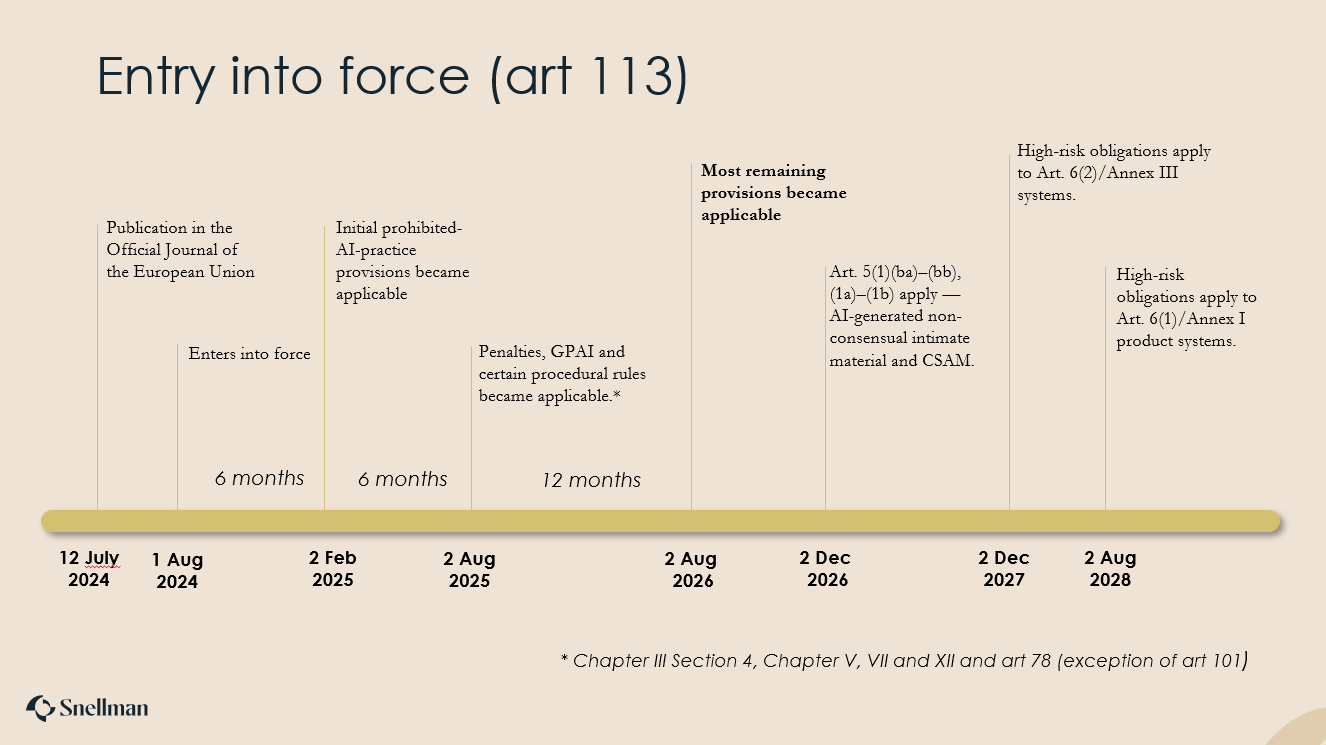
Status: In force. Regulation (EU) 2024/1689 entered into force on 1 August 2024 and applies according to a phased implementation timetable. It was subsequently amended by Regulation (EU) 2026/1744 (the Digital Omnibus on AI) which entered into force on 27 July 2026.
Full name: Regulation (EU) 2024/1689 of the European Parliament and of the Council of 13 June 2024 laying down harmonised rules on artificial intelligence and amending Regulations (EC) No 300/2008, (EU) No 167/2013, (EU) No 168/2013, (EU) 2018/858, (EU) 2018/1139 and (EU) 2019/2144 and Directives 2014/90/EU, (EU) 2016/797 and (EU) 2020/1828 (Artificial Intelligence Act)
Type: Regulation
Objective and key elements:
- The EU’s first comprehensive horizontal regulatory framework for AI
- Aiming to:
- harmonise AI-regulation within the EU,
- protect fundamental rights,
- enhance the positive aspects of AI, and
- ensure free movement of AI systems
- Applies to AI Systems and General Purpose AI
- Includes a risk-based approach depending on AI purposes (and risk levels divided in categories “unacceptable risk”, “high risk”, “limited risk” and “minimal risk”)
Relevant to: Providers and deployers (users) of AI systems and General Purpose AI
Documents (newest on top):
- Digital Omnibus on AI — Regulation (EU) 2026/1744,
- Commission proposal COM (2025) 836 final,
- Original AI Act — Regulation (EU) 2024/1689, current consolidated version,
- Corrigendum (text adopted by the Parliament), published on 19 April 2024, link
- Parliament’s adopted negotiation position mandate, compromise text
- Updated with inter alia tailor-made regimes for general-purpose AI and foundation models (like ChatGPT), read more
- General approach by the Council published 6 December 2022, link
- EU Commission draft 21 April 2021, link
(Last updated 11 August 2026)