
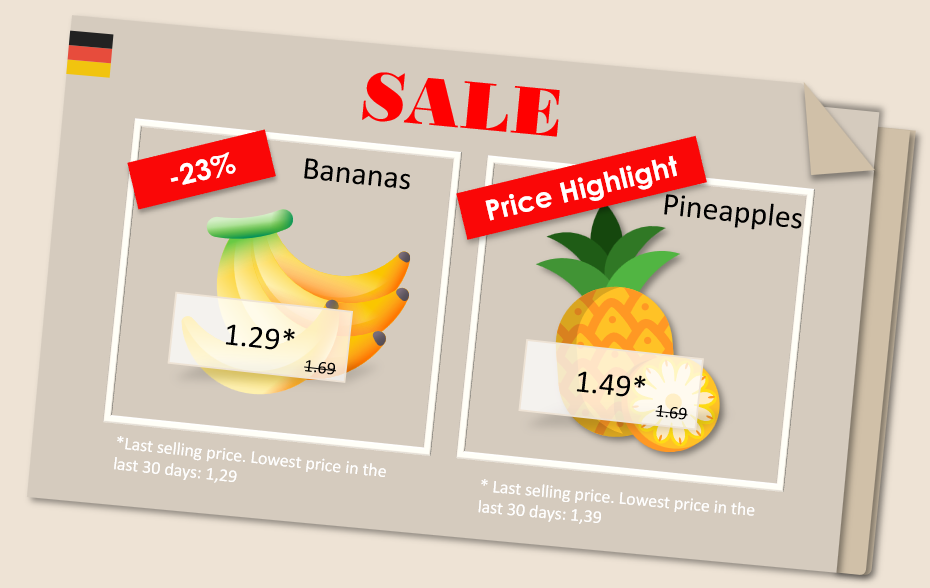
On 26 of December 2024, the European Court of Justice (“ECJ”) delivered its judgement in case C-330/23 (Aldi Süd) on the interpretation of article 6a of the Price Indication Directive. In the ruling, the court answered the question of whether the article should be interpreted to require announced price reductions – in the form of percentage or statements intended to highlight the advantageous nature of the announced price, as shown in the images above – must be calculated on the basis of on the lowest price in the last 30 days.
ECJ’s decision:
The ECJ noted that while the wording of the article does not make it possible to determine if price reductions must be calculated on the basis of the lowest price in the last 30 days, account must be taken of the directive’s and the article’s objectives, such as improving consumer information, facilitate price comparisons and to protect consumers from being mislead by false price reductions. The court stated that an interpretation of the article where it is sufficient to mention the lowest price in the last 30 days for informational purposes, and not to base price reduction on said price, would undermine the objectives. In light of this, the ECJ concluded that price reductions must be calculated on the basis of the lowest price in the last 30 days.
In addition to the question at hand, the ECJ also stated that if follows from the above conclusion that a price announced as reduced cannot be the same or higher than the lowest price in the last 30 days.
Implications for businesses:
The ECJ’s ruling has major implications for retailers and other companies advertising to consumers as it imposes strict limits on the use of reference prices in advertisements of price reductions. It should, however, be noted that the ECJ did not strictly ban the use of other reference prices in advertisements. Nevertheless, companies engaging in the Swedish market should, however, note that it is the opinion of the Swedish Consumer Agency, the supervisory authority, that it is typically not allowed to use additional reference prices alongside the lowest price in the last 30 days as the agency in general considers it to be misleading.
Please do not hesitate to contact us at Snellman if you have any questions concerning how the judgment may affect your business or how your company can announce price reductions in Sweden.